

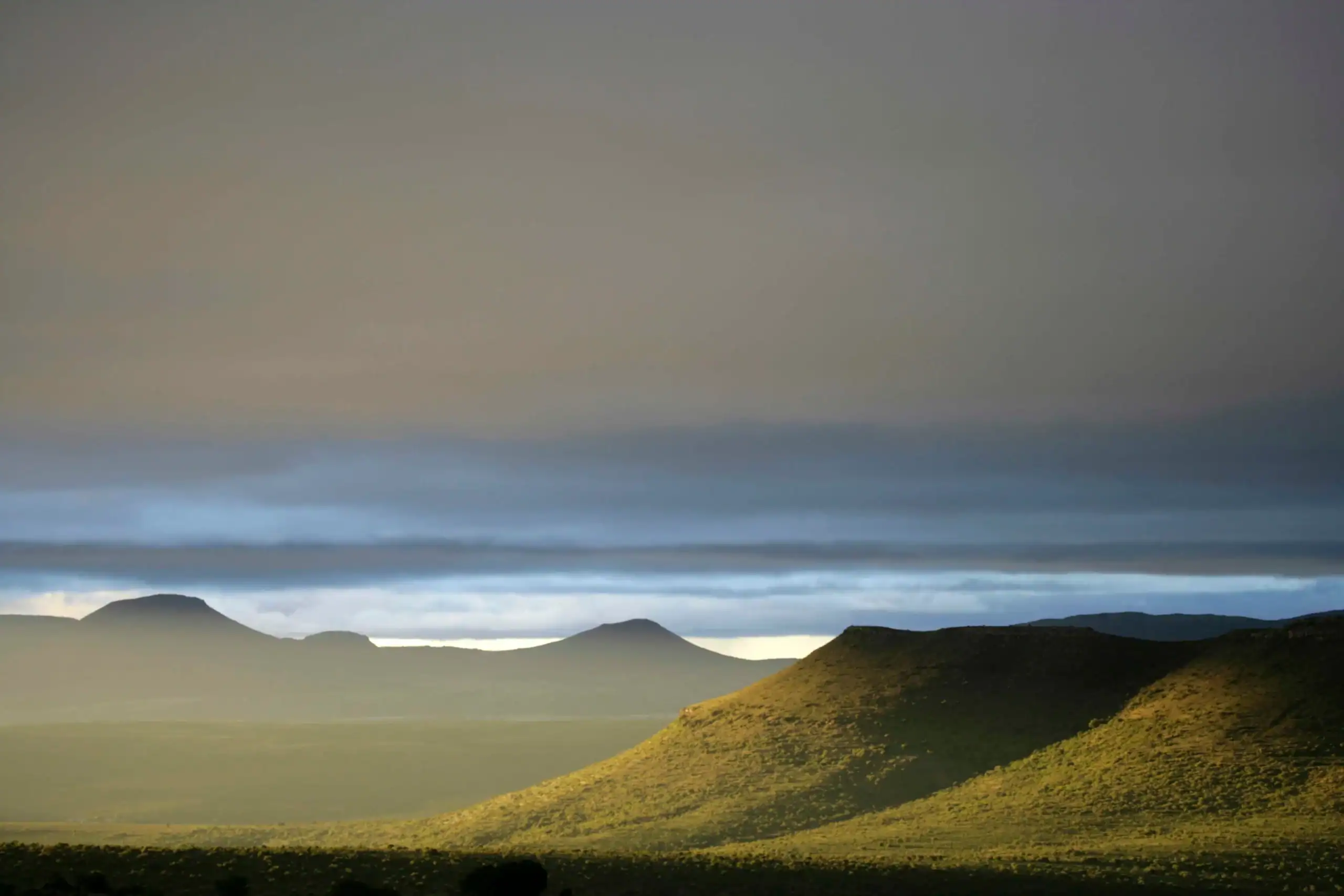
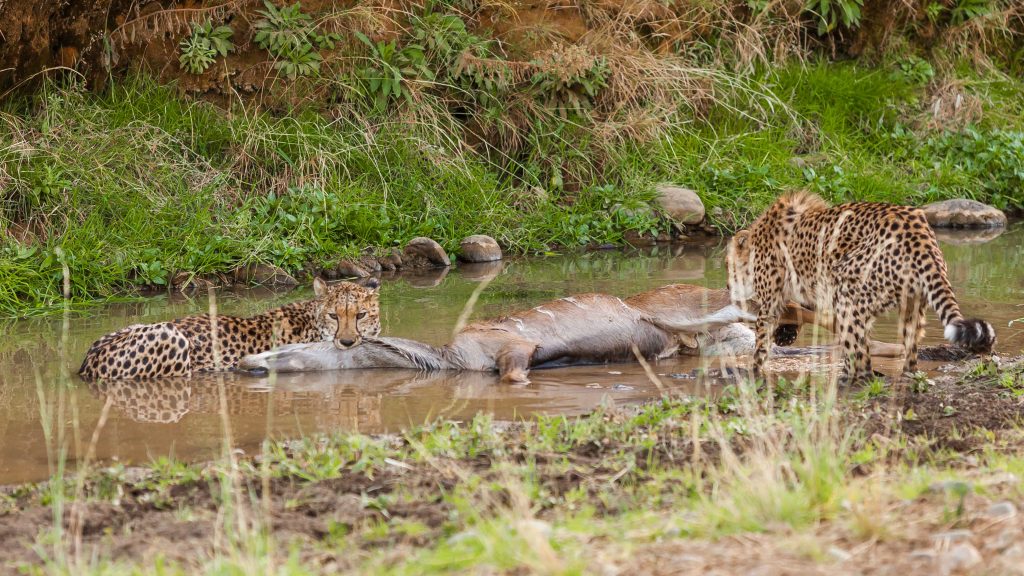
At Samara Karoo Reserve in South Africa’s Great Karoo, cheetahs form part of a broader conservation story focused on restoring biodiversity and rebuilding a functioning ecosystem. Knowing what cheetahs eat, how they select their prey and why these hunting relationships matter is key to understanding cheetahs’ impact as predators within this unique landscape.
What Do Cheetahs Eat?
Cheetahs are carnivores that primarily hunt small to medium-sized ungulates (herbivores with hooves). While they are capable of tackling a variety of prey species, research shows that cheetahs generally favour prey that provides enough nutritional value while still remaining manageable for a predator that is built for speed over strength.
Studies done on Samara have shown that cheetahs tend to select prey within a particular size range, between 10–35 kg (such as steenbok, springbok and red hartebeest calves) and 23–56 kg (such as warthog, kudu calves and impala) depending on the ecosystem and available prey species.
Rather than simply targeting the most abundant animal, cheetahs make calculated decisions based on a combination of factors, including prey size, age, vulnerability and availability.
According to these studies, between 2010 and 2012, kudu accounted for 63% of recorded cheetah kills at Samara, highlighting their importance within the reserve’s predator-prey dynamics.
However, this does not mean that all kudu are equally vulnerable. Cheetahs often select younger individuals of larger species, with juvenile kudu representing a more accessible prey option compared to fully-grown adults.
How Do Cheetahs Choose Their Prey?
A cheetah’s diet is shaped by more than simply the animals that share their habitat. Their hunting decisions are influenced by opportunity, energy requirements and the characteristics of individual prey.
Research shows that prey selection can vary according to species, age, sex, body size and vulnerability.
For example, while larger antelope may be present within a cheetah’s habitat, their size and strength can make them less suitable prey. Attacking larger prey may make cheetahs vulnerable to injury and even death. Instead, cheetahs often focus on individuals that provide the greatest chance of a successful hunt while minimising the risk taken and energy spent during pursuit.
This careful selection is one of the reasons cheetahs are such specialised predators — every hunt is a balance between opportunity and risk.
How Does a Cheetah Hunt?
A cheetah’s hunting strategy is unlike that of many other large predators. Rather than relying on strength alone like lions, leopards and spotted hyaenas, cheetahs use a combination of exceptional eyesight, patience and explosive speed.
A typical hunt involves:
- Scanning the landscape to locate suitable prey
- Moving closer while remaining concealed
- Selecting an opportunity where success is most likely
- Bursting into a rapid pursuit
Cheetahs are famous for their speed, able to reach top speeds of 100-120 km/hour within just 3 seconds. However the eventual success or failure of a hunt is shaped long before the chase begins. Positioning, timing and choosing the right prey are all essential components of a cheetah’s hunting process.
Research also shows that cheetahs do not rely only on open plains when hunting. While open grasslands allow for pursuit, areas with vegetation cover, including woodland, shrub and thicket habitats, can provide useful opportunities for stalking and approaching prey before a chase begins. Interestingly, it is thought that cheetahs’ preference for open habitat arises from their own feeling of safety – in thicker bush, they are more susceptible to competition and predation from larger ambush hunters. Predators like lions and spotted hyaenas will not hesitate to chase cheetahs off their kills or eliminate their cubs.
The Role of Diet in a Healthy Ecosystem
A predator’s diet tells us much more than what an animal eats — it reveals the relationships that keep an ecosystem functioning.
Cheetahs depend on landscapes with healthy prey populations and connected habitats. Protecting cheetahs therefore means protecting the wider ecosystem that supports them.
The presence of predators also influences the behaviour of prey species. Research at Samara has shown that kudu adjust their behaviour in response to cheetah presence, becoming more vigilant and reducing the time they spend feeding in areas where they perceive increased risk. In ecology, this is known as “the landscape of fear”. By shaping how antelopes browse and graze the vegetation, predators alter not just prey behaviour but the underlying health of the ecosystem.
Cheetahs at Samara Karoo Reserve
Many years ago, cheetahs disappeared from much of their historic range due to habitat loss, human-wildlife conflict and declining prey availability.
Samara’s conservation journey focuses on restoring the natural ecosystem of the Great Karoo, including reintroducing species that once thrived on this landscape. Written records indicate that cheetahs were last seen in the region in the 1870s. In 2003, Samara reintroduced the first cheetah in 130 years: a female called Sibella.
Sibella raised 19 cubs to adulthood across four litters, contributing almost 3% to the population of wild cheetahs in South Africa monitored by the Endangered Wildlife Trust. Sibella died in 2015, but her legacy continues through the cheetahs that roam the reserve today. Read more about her story here.
Through careful monitoring and long-term conservation efforts, the cheetahs at Samara are thriving – demonstrating how predators can both shape and benefit from a restored ecosystem.
A Moment from the Field: Watching a Cheetah Hunt
One early morning, the guiding team set out in search of cheetah — crisp Karoo air flushing our cheeks as the sun peeked over the mountains.
Not long into our outing, a few heads appeared above the Karoo bossies. There was Mbali and her cubs, perfectly positioned out on the open plain.
We approached on foot to get a little closer, but soon realised Mbali had her eye on a nearby herd of springbok. We climbed back into the vehicle, careful not to disturb her approach. She stashed her cubs in nearby cover before beginning a patient stalk through the vegetation.
Then, suddenly, she burst into motion. Bounding across the plain, the hunt was over within seconds. Moments later, her cubs came racing towards her, ready to feed.
We later approached again on foot and spent close to an hour with the family as the cubs ate, played and climbed all over their mother as she recovered after the excitement of the chase.
While sightings like these can be difficult to witness, they are a powerful reminder of the circle of life — and the privilege of experiencing a predator-prey relationship unfolding in a restored wilderness.
Frequently Asked Questions
What is a cheetah’s favourite food?
Cheetahs do not have one single preferred food source. Their diet depends on the prey available within their environment, but research shows they generally favour small to medium-sized ungulates such as springbok.
At Samara, kudu form an important part of the cheetah diet, with research showing that kudu calves represented a significant proportion of recorded kills during monitoring periods.
Do cheetahs eat every day?
Cheetahs do not necessarily need to hunt every day. The frequency of hunting depends on factors such as the success of previous hunts, the amount of food available and the energy requirements of individual animals. Typically, cheetahs will feed every 3-5 days, although females with cubs may need to feed daily.
Do cheetahs hunt at night?
Cheetahs are generally thought to hunt during daylight hours, when their vision allows them to locate prey and sprint most effectively. This is known as diurnal behaviour. However, the cheetahs at Samara have been recorded hunting at night during the full moon, showing that they are adaptable to their environment.
Can guests see cheetahs at Samara?
Guests visiting Samara have the opportunity to view cheetahs as part of guided safari experiences, both from a game vehicle and on foot. Samara offers exceptional opportunities to observe cheetahs in a natural setting while learning about the conservation efforts that support their return to the Great Karoo.
Samara Karoo Reserve is a leading conservation journey to restore 67,000 acres of South Africa’s Great Karoo landscape and beyond through rewilding and responsible tourism. Staying at one of Samara’s lodges acts as a direct contribution to this vision.